

BLOG

Managing Loneliness During the Holidays: Four Tips from a Therapist
It’s the most wonderful time of the year, right? The holidays are meant to be a time of connection and joy, but sometimes they can be a time of disconnection, grief, and isolation, especially if you have recently suffered a loss.
Here are a few tips on how to care for yourself this holiday season...
It’s the most wonderful time of the year, right? The holidays are meant to be a time of connection and joy, but sometimes they can be a time of disconnection, grief, and isolation, especially if you have recently suffered a loss such as death of a loved one, divorce or estrangement, job loss, or a move away from your community. Perhaps the holidays are a reminder of past trauma. Even when everything in your life seems normal, the social expectations around holiday celebrations can be overwhelming. It’s all too easy to get caught up in comparing yourself to others who seem to have it all together, especially through social media. All of these things can not only increase loneliness, but anxiety and depression as well.
If any of this feels familiar, know that you aren’t alone. In the last year, over half of Americans have reported feeling sadness and loneliness during the holidays. Loneliness at the holidays is incredibly common, despite the sparkly veneer of lights and gifts and sweet treats.
Mental Health Struggles During the Holidays
An increased sense of loneliness can lead to maladaptive coping mechanisms, especially ones we may have turned to in the past: substance abuse, disordered eating, and other addictive behaviors like mindless shopping. It’s also common to experience increased relationship conflict with family members and partners, given the social pressure to conform to old traditions that may not be comforting anymore.
Another mental health struggle that many experience during the holidays is meta-emotional cycles: in other words, having feelings about your feelings that exacerbate your despair. For example, you might feel loneliness, and then sadness or self-doubt in response to the loneliness: Why am I so isolated? Is there something wrong with me? Another example might be jealousy that others have partners and big families to celebrate with, followed by shame for being jealous: Why can’t I just be happy for others and content with my life? These meta-emotions often lead to greater distress and dysregulation. All the while the original, primary emotion is unattended to, making matters worse.
Therapy Tips For Managing Your Loneliness During the Holidays
The good news is that there are ways you can reorient yourself during the holiday season to protect and improve your mental health. These strategies may not fix your loss or erase past trauma, but rather, can serve as a touchstone for reminding yourself that you are not alone in the world, and joy is still possible.
Mindfulness practices – Take time to slow down and connect with your thoughts and feelings. A simple practice of journaling, writing down things you’re struggling with and things that you’re thankful for, can have the effect of reducing how overwhelmed you feel and stopping those meta-emotional cycles from spiraling out of control. Or you might try going outside for a winter walk and focusing on your senses to get out of your head and back into your body: enjoy the crunch of snow beneath your boots, the fog in the air, the wind on your cheeks, or a favorite song in your earbuds (even if it’s a sad one).
Make new traditions – Whether it’s because the old traditions don’t feel comforting anymore, or because doing them simply isn’t possible this year due to financial issues or travel constraints, it is okay to try new ways of celebrating. This is possible whether you have people to celebrate with or not. If the thought of trying to celebrate holidays alone makes you feel even more sad or self-conscious, consider an activity that will connect you with others in need, like helping out at a center for unhoused people or underprivileged groups.
Adjust expectations and boundaries – We all go into the holiday season with hopeful expectations that we will be surrounded by loved ones and everyone will have a merry time together, full of joy and delicious food and fun gifts. But some years, that’s just not how it works out, for a variety of disappointing reasons. In these times, adjusting our expectations – and communicating clearly with others to help them adjust their own expectations – can make room for other opportunities to find joy. So maybe this year, gathering together with loved ones just isn’t possible; talking about it early on and making other plans to connect over FaceTime or in-person at a later date can help ease the disappointment and reassure each other that you care. (Read this post for more tips on setting boundaries and expectations with loved ones during the holidays.)
Support through therapy – No matter how lonely you feel this holiday, remember that you don’t have to cope alone. Therapy can help you process your feelings, prepare for the hard moments, and find joy and comfort.
Get Extra Support This Holiday Season
There’s no better time to seek support from a therapist than during the holiday season. You don’t have to wait until the new year to get the support you need. At ECC, our diverse group of licensed therapists can help you process the loneliness of the season and offer new strategies for coping and connecting with others. Book an appointment with us today to get started.
About ECC:
Empowered Connections Counseling is a practice of licensed therapists providing quality, multidisciplinary counseling for adults, children & teens, relationships, and families in Chicago and across Illinois. Whether by in-person session or via telehealth, we work with clients to find the therapist and treatment methods that best suit their needs. Connect meaningfully with your life by booking an appointment today.

What Matters More: The Therapy Method, or the Therapist?
If you’re new to therapy, you may find yourself wondering which type of therapy is right for you, and beyond that, what is more important: the therapist, or therapy method? Perhaps you’ve met with a therapist before and it didn’t go well, but you’re not ready to give up on therapy yet. The good news is that research has given us some good indicators on how to set ourselves up for success in a therapy relationship—for both therapist and client.
If you’re new to therapy, you may find yourself wondering which type of therapy is right for you, and beyond that, what is more important: the therapist, or therapy method? Perhaps you’ve met with a therapist before and it didn’t go well, but you’re not ready to give up on therapy yet. The good news is that research has given us some good indicators on how to set ourselves up for success in a therapy relationship—for both therapist and client.
What the Research Shows About Effective Therapy Experiences
According to foundational studies in psychotherapy, such as Lambert 1992, there are a few important components that contribute to therapy’s overall effectiveness for a client.
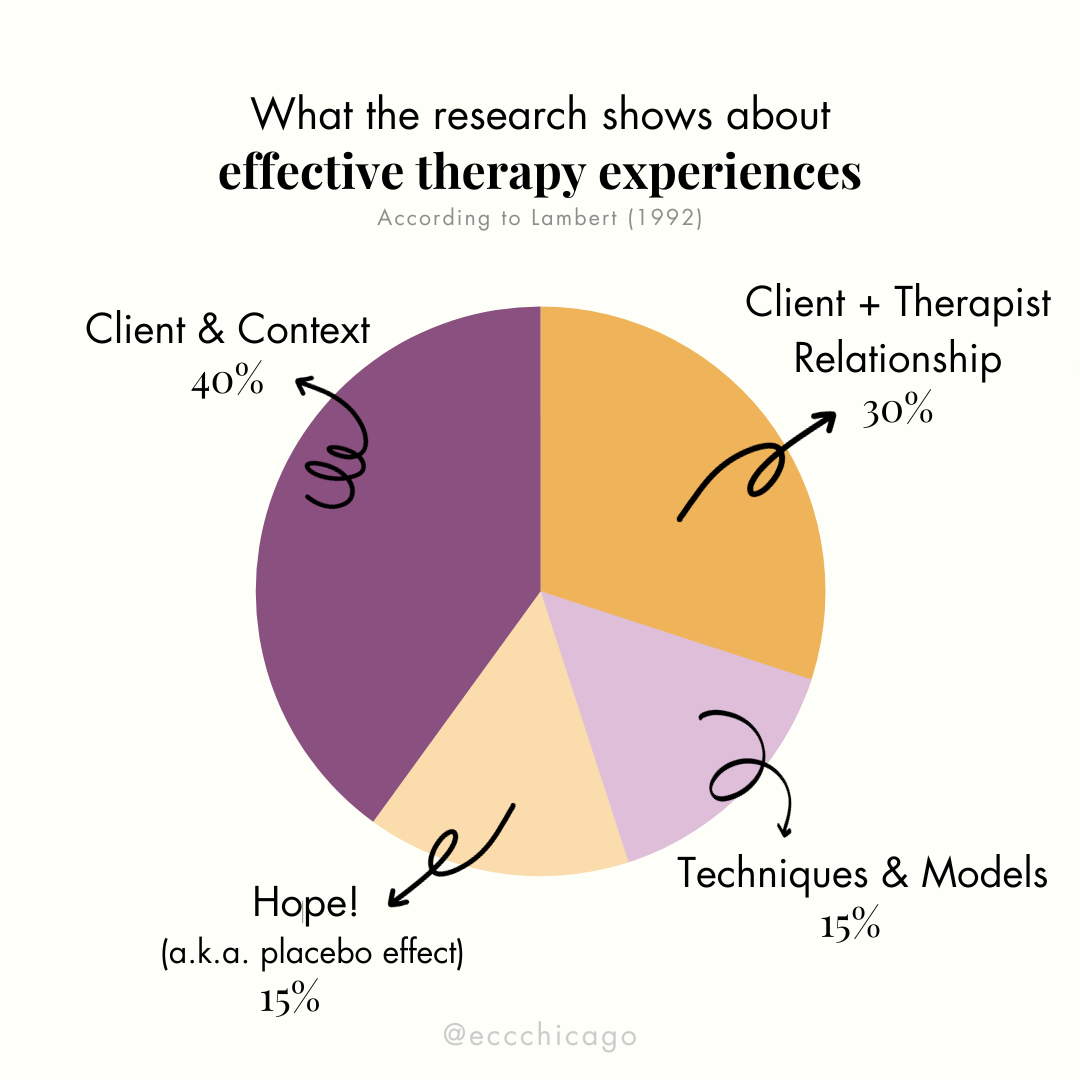
30% : Client-Therapist Relationship – Does the client feel safe, heard, and cared for in their therapeutic relationship? This is the biggest factor in the therapist’s control toward creating a helpful outcome from your therapy experience.
15%: Technique & Models – These are the therapist’s tools and techniques for approaching a client’s needs. There are many different modalities in therapy, a few you may have heard of: Emotionally Focused Therapy (EFT), Dialectical Behavior Therapy (DBT), Attachment-based Therapy, Cognitive Behavioral Therapy (CBT), and Eye Movement Desensitisation Reprocessing (EMDR).
15%: Hope (a.k.a., the Placebo Effect) – This is the client’s attitude towards therapy and their hope in the process itself, but the therapist plays a role here in instilling hope for the client’s ability to grow and change.
40%: Client and Contextual Factors – This is the client’s willingness and readiness for change, but it also includes outside forces that may impact a client’s well-being, stressors, access to basic needs and medical care, as well as other factors including job changes, parenthood, etc.
With all of this in mind, the most important elements in choosing a therapist are the quality and connection in the therapeutic relationship. Change can occur across modalities—but if you like the approach and don’t feel completely safe or understood with the therapist, you’re less likely to experience positive change. Ideally, you should feel empowered to have a quality therapeutic relationship alongside a model and technique that is effective for your needs.
Tips for Finding the Right Therapist and Method
Online searches may pull up hundreds of different options as you search for a therapist near you, and that can be very overwhelming, especially if you’re already experiencing stress in your life. If you’re stuck on how to find the right fit, here are a few tips for starting your search:
Think about your goals for therapy. What parts of your life, or what ways that you cope, do you hope to improve? Knowing your goals can help you pick the modality that’s the right fit for you, and build a relationship with your therapist as you work towards a shared goal.
Explore types of therapy that may help you. You can start by asking a friend who has been to therapy, or by researching online. If you’re not sure what to search, you can start with any of the modalities mentioned above.
Search for resources near you. Searching by specialty and location, e.g., “EFT therapists near me” or “EFT therapists in [your city]” can help narrow down your search.
Finding the Right Therapist and Method: ECC’s Approach
At ECC, we know how overwhelming it can be to find the right therapy fit to effectively address your unique needs. We’re committed to helping every client find the right therapist and the right modality, and we’ve designed our intake system to reflect that.
When you reach out to ECC for care, we:
Provide a full list of therapists that have immediate availability, along with their bios and openings. This allows you to choose the therapist that resonates with you, as opposed to a random assignment to an open therapist.
We allow you to set up consultations with clinicians so that you can get firsthand experience to decide if the relationship and methodology are the right fit.
Offer flexible payment options. We can work with your insurance provider, or provide sliding scale or self-pay options if you don’t have insurance coverage.
Our multidisciplinary staff can help you achieve your goals when you’re ready to seek care. Not sure if you’re ready to start therapy? We think the fact that you’re here reading this blog is a good sign. 😉 When you’re ready to get started, fill out our intake form here.
About ECC
Empowered Connections Counseling is a practice of licensed therapists providing quality, multidisciplinary counseling for adults, children & teens, relationships, and families in Chicago and across Illinois. Whether by in-person session or via telehealth, we can work with you to find the therapist and treatment methods that best suit your needs. Connect meaningfully with your life by booking an appointment today.

How To Recognize,Treat, and Prevent Burnout
Burnout is a reaction to prolonged or chronic stress. Burnout symptoms can be difficult to recognize when we are focused on multitasking, which is why it is important that we are checking in with ourselves on how we are feeling.
Burnout is a reaction to prolonged or chronic stress. Burnout symptoms can be difficult to recognize when we are focused on multitasking, which is why it is important that we are checking in with ourselves on how we are feeling. Some burnout symptoms include feeling exhausted, empty, and unable to cope with daily life. When we are experiencing burnout it is very easy to feel out of tune with your emotions and feel mentally exhausted. The mental exhaustion can also show up as physical exhaustion and the feeling of always feeling tired and difficulty with sleep. Burnout can also manifest in physical symptoms such as headaches, back pain, and getting sick often.
5 Tips to Prevent Burnout
Get in the habit of frequent emotional check-ins especially on stressful days.
Make sure that you are practicing self care
Include breaks throughout the day.
Prioritize sleep.
Remind yourself that it is okay to reach out for support if needed.
Burnout is Treatable
The first step to treating burnout is to be gentle with yourself and not beat yourself up..Burnout is normal - not a moral failure.
Remind yourself that it can help to talk to someone and get support, whether that is a friend, mental health professional, or someone else you trust.
Make sure to allow yourself to slow down and give yourself time to recover; rest is vital to be able to treat burnout.
Set boundaries for yourself to make sure that you are managing your time and energy in a healthy way.

Today’s Problem - Yesterday’s Survival
Imagine the first time a client enters a therapist's office, revealing years of self-medicating trauma and anxiety by way of alcohol and drugs. Shame hangs heavy in these moments, with the focus fixed solely on breaking free from dependence and addiction. Yet, as therapists, we are attuned to a deeper truth - that these problematic behaviors were once functional survival mechanisms, borne out of pain. The troublesome coping skills you are faced with today at one time served a crucial purpose.
Imagine the first time a client enters a therapist's office, revealing years of self-medicating trauma and anxiety by way of alcohol and drugs. Shame hangs heavy in these moments, with the focus fixed solely on breaking free from dependence and addiction. Yet, as therapists, we are attuned to a deeper truth - that these problematic behaviors were once functional survival mechanisms, borne out of pain. The troublesome coping skills you are faced with today at one time served a crucial purpose.
The coping journey from function to detriment can manifest in different ways: substance abuse, disordered eating, addictions, avoidance, people-pleasing, isolation, etc. Regardless of the coping mechanism and the pain they may be causing you today, at one point they served a purpose.
Self-compassion is essential as a starting point - you were (and are) doing the best you can to try to manage distressing emotions by whatever means necessary even if self-destructive over time. You didn’t set out to develop a maladaptive approach to life or relationships - you were trying to survive a painful experience.
The good news is that there are other ways to attend to and manage distress outside of the coping skills you cultivated across the lifespan. We must address the underlying problem and the problematic solutions. In therapy you can uncover not only the why but also the how to approach challenges or situations in a more sustainable way that aligns with your values.

New Year, New Regrets? How Examining Regret Can Propel You Forward
As we settle into 2023, for some of us it is time to wonder: Will we or won’t we follow through on our resolutions? Or are we already regretting the goals we made for ourselves?
As we settle into 2023, for some of us it is time to wonder: Will we or won’t we follow through on our resolutions? Or are we already regretting the goals we made for ourselves?
Before we review new resolutions, I want to suggest a moment to look back. Instead of looking up the mountain for all you want to accomplish or change in the new year, take a minute to look down your mountain and acknowledge how far you have come in the last year.
Write down some of your accomplishments from last year. No paper? Say them out loud.
I encourage you to call someone and tell them what you are proud of – better yet – start the conversation–ask the person on the other end of the call to “look down their mountain”. Have them tell you something they are proud of from the past year.
It isn’t bragging, it is empowering.
Along with accomplishments, I confess, I have a lot of regrets from the past year. I have been taught my entire life from bad bumper stickers “NO REGRETS!” to religious acts (Confession?!) that regrets are something to avoid. And although we are bound to make some mistakes, the act of embracing regret certainly has been frowned upon.
Instead of avoiding these mistakes or missed opportunities, what about examining our regrets? Daniel Pink, in his nonfiction book: The Power or Regret: How Looking Backward Moves Us Forward, compiles quantitative data to support the importance of reflecting on those things we regret the most. Pink not only uses science to support his claim, but he gives us permission to embrace our regrets!
Pink breaks regret into four types:
Foundation Regrets
Moral Regrets
Connection Regrets
Boldness Regrets
Pink explains each type has something to teach humans about what they value: “foundation regrets” reveal a need for stability, “connection regrets”, the need for love, “moral regret”, the need for goodness and “boldness regrets” suggest a need for growth. If so many of us are living with regret, how do we maximize our regrets to live a more fulfilling life? Pink goes on to describe a three step strategy: inward, outward, forward. He also suggests a number of exercises to support these ideas.
A month into the new year and already I have a few regrets. Instead of punishing myself, I am going to review Pink’s exercises and remember that looking backward can move me forward.
Read or listen more about Pink’s theory on regret: How examining our regrets can make for a more meaningful life